2 pork tenderloins, silver skin removed, cut into 1-2 inch chunks
kosher salt, to taste
freshly ground black pepper, to taste
flour, for dusting
2 tablespoons Olive oil
2 tablespoons shallot, minced
2 garlic cloves, minced
1 tablespoon ginger, minced
2 cups fresh cherries, pitted, halved
½ cup port wine
½ cup dry sherry
1½ cups chicken stock
1 tablespoon, mixed finely chopped thyme and rosemary
1 tablespoon Worcestershire
2 tablespoons butter
Season the pork with salt and pepper. Lightly dust with flour, shaking off any excess. Heat the olive in a large skillet and add the pork. Sear all over until barely golden on all sides and remove. If the pan is dry, add another drizzle of oil. Add the shallot, garlic and ginger and cook for 2 minutes, until fragrant. Add half of the cherries, half the port wine and half of the sherry and the chicken stock. Reduce by half and add the seared pork back in, the Worcestershire and herbs and the rest of the port and sherry wine. Simmer for about 4-5 minutes allowing the pork to fully cook and the sauce to thicken a bit. Add the rest of the cherries and swirl in the butter, check for salt and pepper and serve.
JEROME — Magic Valley ranchers have talked for years about the need to increase beef processing capacity in the region.
Now a big boost is on the way.
On Friday, True West Beef announced it’ll be building a new beef processing facility near U.S. Highway 93 within Jerome’s area of impact. The company has received tax incentives from Jerome County for the project. True West Beef is owned by Boise-based Agri Beef.
Governor Brad Little talks about his excitement for the upcoming True West Beef processing plant Friday at the Jerome County Airport. True West Beef will produce products for two high-end beef brands, giving Magic Valley ranchers access to a niche market.
PAT SUTPHIN, TIMES-NEWS
The Jerome facility will process 500 head of cattle a day and will employ nearly 400 workers at an average salary of $52,000 a year. The company does not yet know exactly when that facility will be finished or how much it will cost.
“This is a generational moment for everybody in this valley,” Oakley rancher Doug Pickett said. “It’s something we’ve hoped for for years.”
Historically, most Magic Valley-raised cattle have been shipped out of the region or state for processing. Long-distance shipping can mean less profit for producers. There are a few smaller processors in south-central Idaho — perhaps most notably Ida-Beef in Burley, which opened in 2018 and specializes in dairy cull cows — but local producers have long been eager to have more meatpackers.
Robert Rebholtz Jr., president and CEO of Agri Beef, announces plans for the upcoming True West Beef processing plant Friday at the Jerome County Airport.
PAT SUTPHIN TIMES-NEWS
Idaho Gov. Brad Little, a rancher, attended True West Beef’s unveiling Friday at the Jerome County Airport and said the company will be a boon both to the cattle-rich Magic Valley and the state. This will add value to local beef, he said.
“It so reflects what everyone in Idaho wants to see,” Little said. “I can’t think of anything more valuable.”
Finding a niche
Agri Beef’s business covers virtually every step of the beef supply chain, from genetics operations, nutrition products and feedlots to processing, niche product marketing and online overnight beef sales. The company has feedlots in Idaho and a mid-size processing facility in Toppenish, Washington.
Much of Agri Beef’s business is focused on high-end, niche foods. Agri Beef owns the Snake River Farms, Double R Ranch, St. Helens Farms and Rancho El Oro brands. Some of those brands can be found in Magic Valley grocery stores, and some Agri Beef products have been lauded by professional chefs or appeared on national cooking television shows.
Snake River Farms Wagyu cattle are raised in eastern Idaho, while Double R Ranch beef is raised in Washington.
While an increase in local processing capacity will likely be a big benefit for some ranchers, it’s not only the beef packing that has some producers excited. The Jerome processing plant will mainly produce Snake River Farms and Double R Ranch products. Those brands are growing more popular, which is why Agri Beef needed to ramp up its processing capacity.
“It’s not just 500 head, it’s 500 head of highly, highly prized, value-added, highly-marketed livestock that’s going to go throughout the world,” Little said. “This is a big, big addition.”
When Agri Beef markets the Snake River Farms and Double R Ranch brands, it emphasizes that they come from Idaho and the Northwest. Some consumers are increasingly drawn to products that can be traced back to a specific region.
Magic Valley ranchers who can sell their beef to niche markets could see bigger profits.
“That’s huge for these ranchers,” Idaho Rep. Laurie Lickley said. “They don’t have to develop their own brands and labels.”
Pickett noted that most Magic Valley ranchers have never had an opportunity to market their beef like this. He said that bringing recognizable, desired brands to the area will help ranchers keep their operations going for future generations.
“I can’t imagine a better scenario,” he said. “It’s the next step in diversifying our ag economy and giving us a chance to be more stable going forward.”
An unusual model
Not only will some Snake River Farms and Double R Ranch beef come from the Magic Valley and be processed in a Jerome facility, some Magic Valley ranchers will partially own that facility.
True West Beef will have a somewhat unusual ownership arrangement. Agri Beef will be the majority owner of the Jerome plant, but the ranchers who provide beef to the facility will also have equity. True West Beef Executive Vice President Jay Theiler said the company will know in the next month or two which producers will be partial owners of the plant, but it’s highly likely some of them will be Magic Valley ranchers.
“We believe that this model can serve as a new way for beef processing to expand in the U.S. and meet consumer needs,” Thieler said.
Little noted that other Idaho products already have great marketing and brand recognition. And for many Gem State staples a lot of processing is done in state, keeping more of the revenue here.
Adding True West Beef will help make that true for the beef industry.
“We’ve got the dairy industry pretty well taken care of,” Little said. “We’ve got the potato industry pretty well taken care of. The gaping hole was the beef industry.”
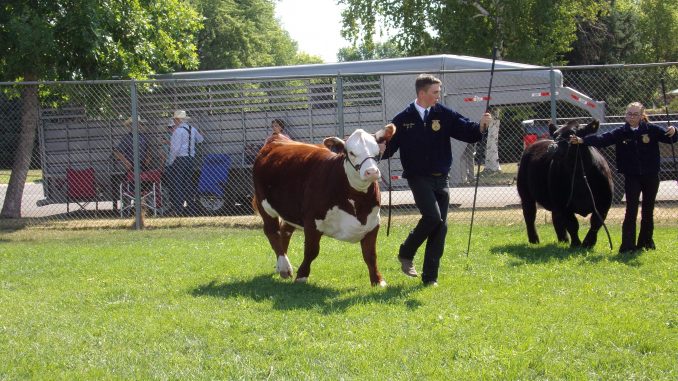
The COVID-19 pandemic has produced mixed results for 4-H and FFA youth working with beef this year.
On the negative side, Market Beef Superintendent Kandra Ankney said beef prices are currently on a roller coaster. But, she said, there’s a positive side.
By “they,” Ankney said, she meant consumers in the local community. She said they are learning that there are ranchers and youth who will sell directly to them.
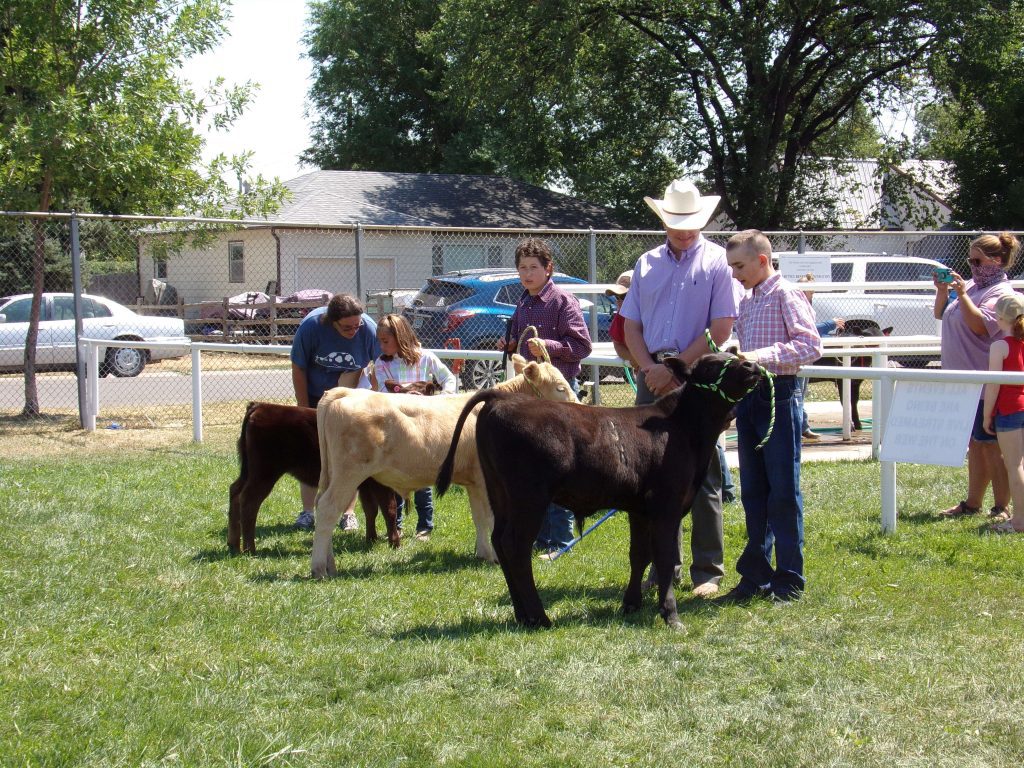
The judge looks over entries in the bum calf show. (Photo by Pat Blair)
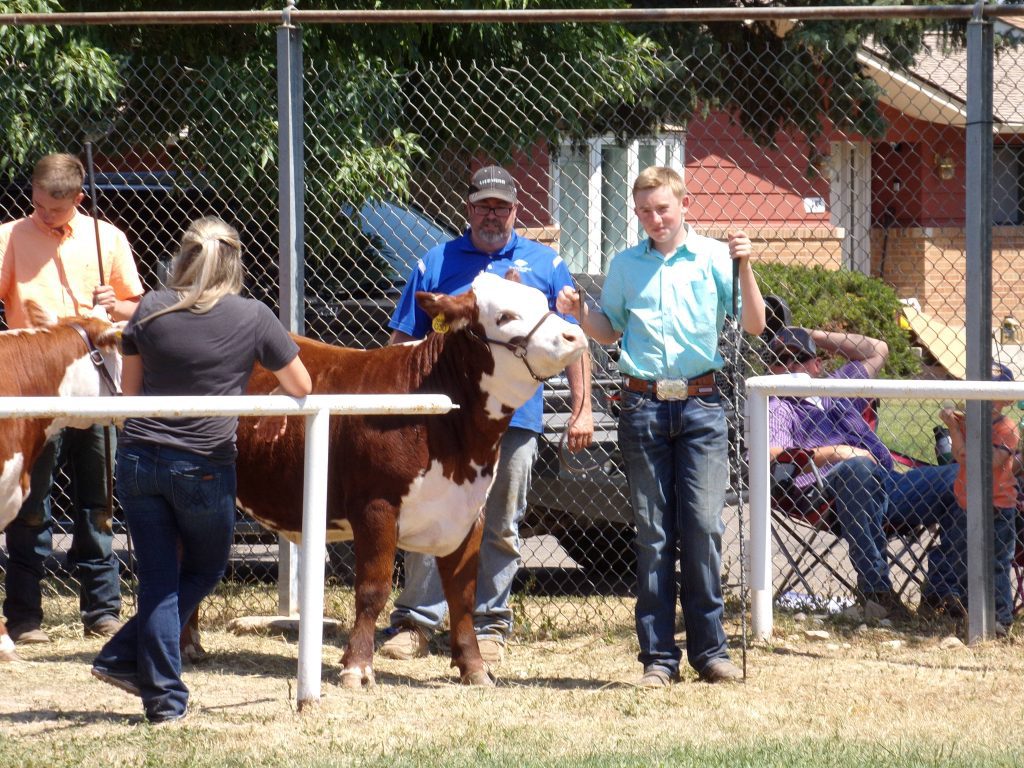
All of the beef shows at this year’s Sheridan County Fair were held Saturday, starting with market beef and showmanship in the morning, followed by the bum calf, heifer futurity and breeding beef show in the afternoon. Ankney said market beef numbers this year were down a little from the around 50 animals shown in years past.
She said given the COVID-19 restrictions, the youth this year were ecstatic just to be having the fair. She said probably the biggest disappointment was that they don’t get to stay on the fairgrounds and participate in all the activities that are normally part of fair week. Shows this year have been done jackpot-style, with animals brought onto the grounds on the day of the show and taken home immediately after the show is done.
Competitors wait their turn for the first heifer futurity class. (Photo by Pat Blair)
Ankney said she had nine Cloverbud participants in this year’s bum calf show. Cloverbuds are the children between 5 and 8 years old, not quite old enough yet to join 4-H. Ankney said there also were five 4-H and FFA participants in the bum calf show. She said that’s comparable to previous years.
She said the heifer futurity, which is a two-year program, also was holding steady with past years.
North American distributors have some beef with the meat industry. On Friday, JBS Food Canada, ULC recalled over 38,000 pounds of beef products after they failed to be re-inspected when entering the United States. And turning up the heat doesn’t seem to be the solution here.
The USDA labeled the affected products under a Class I recall, which means the products can cause “a health hazard situation where there is a reasonable probability that the use of the product will cause serious, adverse health consequences or death,” according to the organization’s official announcement.
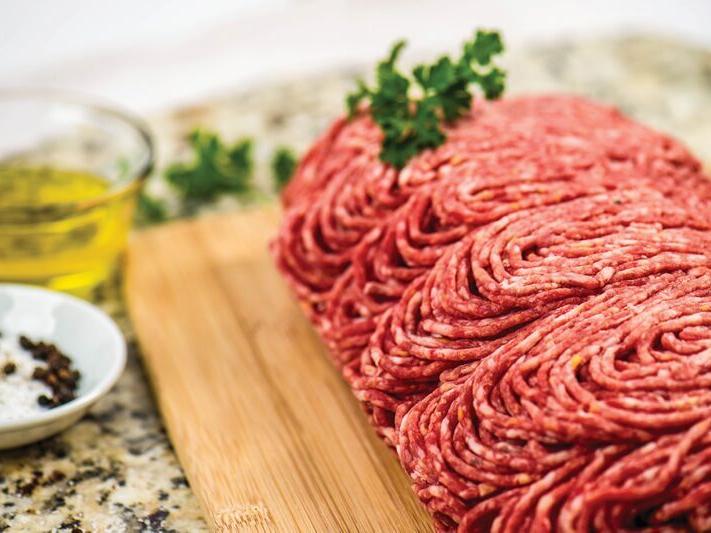
This recall concerns 80-pound boxes of 10-pound ground meat packages that were sent to distributors in Florida, Georgia, North Carolina, and South Carolina before being sent to retail locations. Thus far, there are no reported cases of adverse effects from related meat consumption in these areas. However, the USDA recommends proceeding with caution and throwing out any products that could potentially be contaminated.
And, as though 2020 could not be a more anxiety-inducing year, ground beef contamination has been all too common lately. In June, Walmart had to recall 40,000 pounds of its grass-fed beef due to potential e-coil contamination. Some of your chicken products might not be safe, either. At least, the processed form. Also, later in June, the USDA recalled almost 60,000 pounds of Pilgrims chicken nuggets.
JBS Food Canada ULC has recalled about 38,406 pounds of beef products because they were not presented for import re-inspection into the United States.
According to the recall issued by the U.S. Department of Agriculture’s Food Safety and Inspection Service (FSIS), these arrived as boneless beef head meat products and were imported earlier on July 13. They were then "further processed by another company into ground beef products."
The items included in the recall are 80-pound boxes that each contain 10-pound "chubs" of Balter ground beef with "use or freeze-by" dates of 08/09/2020 or 08/10/2020. They were sent to distribution centers in Florida, Georgia, North Carolina, and South Carolina, and were then sent to retail locations to be sold. You can find additional info about the specific items that were recalled, including their lot numbers, in the recall notice.
There have been no reported illnesses or adverse effects in connection to this recall, but the FSIS has designated these items as having a high health risk and classified it as a Class I Recall, which means there is a "health hazard situation where there is a reasonable probability that the use of the product will cause serious, adverse health consequences or death."
FSIS said it is concerned that people might have these in their freezers or fridges and urges the public not to consume them, but rather to throw them away or return them to where they bought them from.
This recall comes a few days after a similar recall by Jamaican Tastee Patties, LLC that recalled 60,000 pounds of meat and poultry patty products. These products were repackaged, relabeled, and redistributed without being federally inspected. They also added a mark of inspection of "another federal establishment without proper authorization." You can find info on that recall here.
Governor Brad Little talks about his excitement for the upcoming True West Beef processing plant Friday at the Jerome County Airport. True West Beef will produce products for two high-end beef brands, giving Magic Valley ranchers access to a niche market.
Here's a question you might not have considered: Do mosquitos spread COVID-19? The answer, thankfully, is no. But in the latest episode of the Around Farm Progress podcast, P.J. Griekspoor, editor, Kansas Farmer, shares the story of a K-State mosquito expert who wasn't willing to take the "it's safe" message at face value. She offers insight into his research proving there's no worry.
Griekspoor is also following a three-year project supported by General Mills focusing on regenerative agriculture. She offers some background on the farmers involved and the work ahead.
Burt Rutherford, editor, BEEF Magazine, got to do something few have done in recent weeks – attend a meeting. The National Cattlemen's Beef Association held its summer business meeting in-person, and virtually, in Aurora, Colorado, and he attended. He offers a look at the business conducted. And even shares that while he was following those social distance and mask rules, that can still be hard.
More podcasts and coverage
Beyond Around Farm Progress we've got more podcasts to share. Check out all our podcast links at FarmProgress.com/farm-progress-podcasts to keep up on not only Around Farm Progress but daily updates from Max Armstrong, and more.
And if you want quick access to top news from Farm Progress, sign up for our mobile text service by texting FARM to 20505. Note that there may be a text or data cost for using the service.
The podcast Around Farm Progress goes live online by 3 p.m. Central time each Friday and will engage editors from around the country. You can listen to this week's episode above and subscribe on Podbean at Around Farm Progress the podcast. And you can now subscribe through Spotify, Google Play and the Apple podcast app. Just search "Around Farm Progress" and subscribe so you don't miss an episode.
Farmers are getting their information in new ways. Farm Progress is a leader in reaching them as needed. From top magazines around the country to one of the first agriculture-focused mobile apps from Farm Futures, to the leading television presence with This Week in Agribusiness, the company covers all media for agriculture.